Amazon Associates 2026 Rule Changes: What to Fix on Your Blog and Pinterest Pins
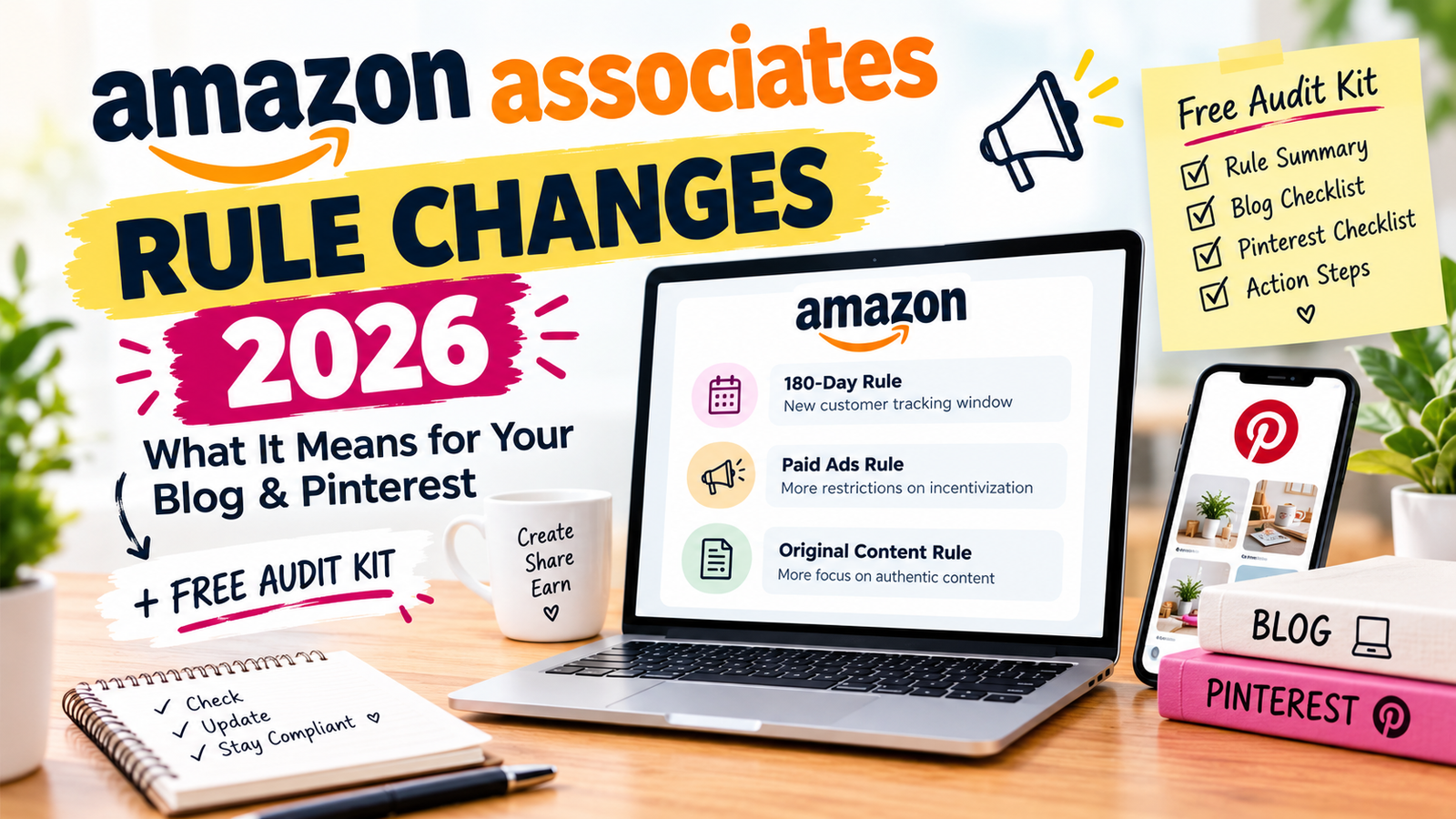
Amazon updated its Associates Program Policies on April 14, 2026. The changes add a 180-day shipping-and-payment limit, disqualify sales from customers referred through ads you bought, narrow onsite commission to the linked product, and define “original content” as commentary, analysis or transformation. Audit pages that only list Amazon links first.
In this guide
- The policy says links to product lists, such as search results, events or department pages, need extra original content on your site
- Sales from customers referred through advertisements you purchased are disqualified
- The 180-day rule is a shipping and payment deadline, not a cookie window
- Amazon decides what counts as original content in its sole discretion, so aim for clear value, not the minimum
What changed on April 14, 2026?
Amazon’s “What’s Changed” page lists four updates to the Associates Program Policies, effective April 14, 2026. I read the change log and the full policy text on October 6, 2026. Here is what each says, and what to do about it.
| Change | What the policy says | What to do |
|---|---|---|
| 180-day limit | To qualify, the product must be shipped, streamed or downloaded, and paid for within 180 days of the purchase | Expect slow-shipping, backorder and pre-order items to carry more risk |
| Ads you buy | Purchases by customers referred through an advertisement you purchased are disqualified, and the change log says paid or boosted ads are covered even without prohibited keywords, with limited exceptions | Do not pay to promote Amazon links. See the Pinterest section below |
| Onsite commission | Calculated only on direct purchases of the same product variant as the linked page | Link to the exact product you recommend |
| Original content | Original content must contain commentary, analysis or transformation that adds value | Audit thin pages |
The 180-day number is easy to misread. Some bloggers describe it as a new cookie. The policy text doesn’t say that. It describes how long a sale has to settle. Clicks still start a session that ends after 24 hours, and a product added to the cart in that session can qualify if the order completes within 89 days of the click.
Country programs differ slightly. The UK Associates page words the onsite commission change a little differently from the US one, so read your own country’s version.
Which of your pages are at risk?
The Participation Requirements add a rule that matters for many blogs. When you link to pages with product lists, Amazon says you must have additional original content on your site that is relevant to the link. It defines product lists as search results, events such as Prime Day, and department homepages.
That affects any post that sends readers to an Amazon search URL, as many “shop the look” posts do. A search-results link is convenient, but it isn’t a single product. If it sits under a thin paragraph, the page is the type most exposed.
| Page type | Risk | Why |
|---|---|---|
| Single product review with your own testing and photos | Lower | Clear commentary tied to one product page |
| Roundup with a real note on each pick | Medium | Depends on whether each note says something specific |
| List of product links with one-line blurbs | High | Little analysis beyond the links |
| Links to Amazon search results or department pages with thin text | High | Product-list rule: needs extra original content |
| Pages built around pre-order products | High | Pre-release items not on a listing page are disqualified |
What counts as original content?
Amazon’s wording is “commentary, analysis or transformation for additional value.” It doesn’t give a word count, and it says it decides suitability in its sole discretion. So don’t aim for the minimum. A reader should learn something from your page that the product listing doesn’t say.
Useful commentary tends to include who the product suits and who should skip it, the trade-offs, how you chose between options, and anything you tested yourself. Only write “I tested” if you did. False testing claims create a separate problem under the FTC’s endorsement rules.
What do the changes mean for Pinterest and paid ads?
The policy disqualifies purchases from customers referred through “any advertisement that you purchased”, and the change log extends this to paid or boosted ads. The rules on sending paid traffic to your own site instead of Amazon are less clear. One policy section permits paid search ads that send users to your site, while the disqualification list is broader. I could not resolve that from the text.
The safe approach is simple:
- Organic pins only for Amazon links. An organic pin that leads to your post that links to Amazon is the pattern the policies describe most clearly.
- No Promoted Pins that link to Amazon, directly or through a redirect.
- If you want to promote a post that carries Amazon links, ask Associates Customer Service in writing first and keep the answer.
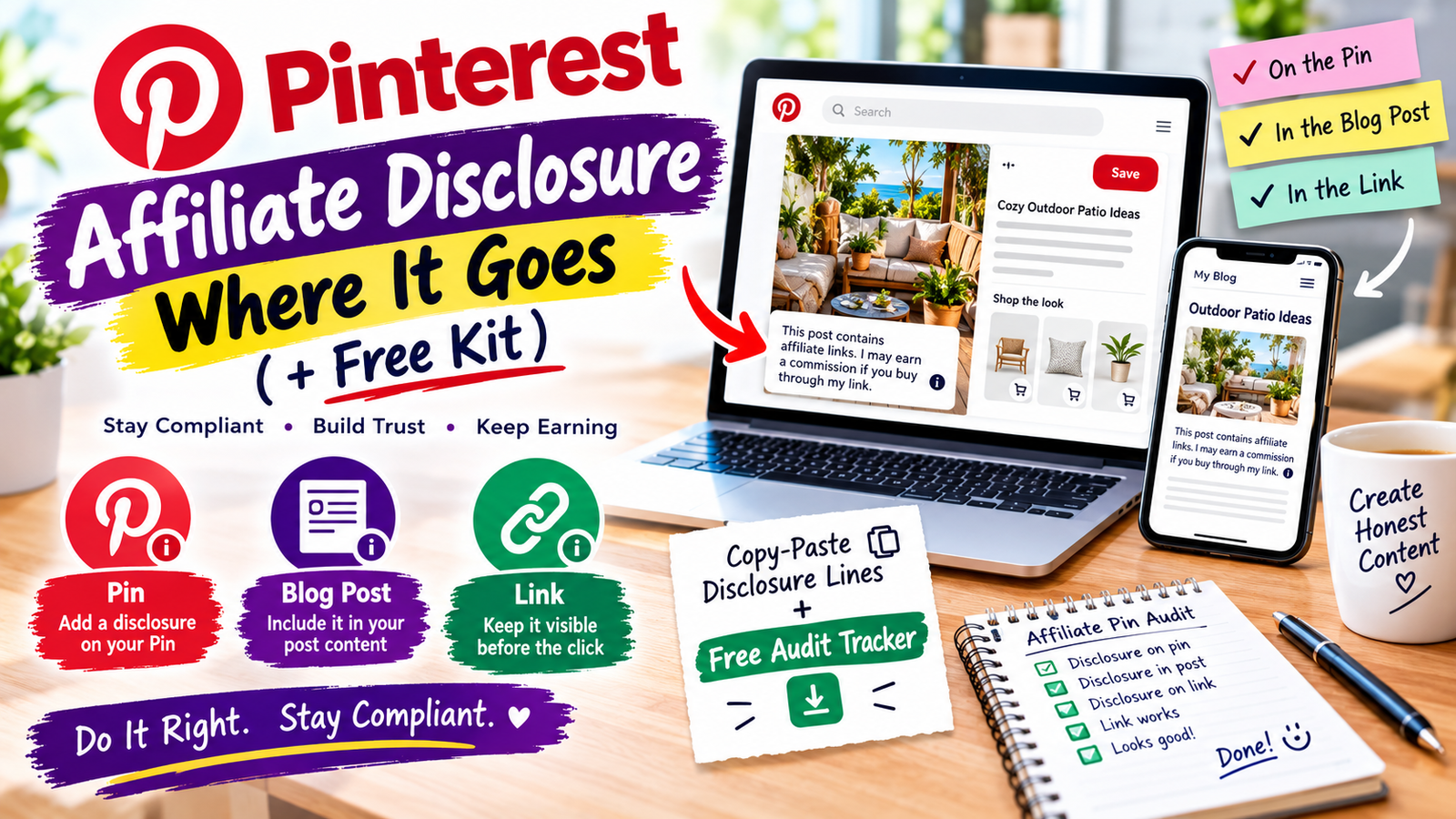
Pin disclosure is a separate rule set. See our guide to Pinterest affiliate disclosure.
What other rules trip up bloggers?
While reading the policies, I found these rules that blogs often break by accident:
| Rule | In plain words |
|---|---|
| Prices and availability | Show them only if Amazon serves the link that displays them, or if you pull them through Amazon’s API with required timestamps |
| Star ratings and customer reviews | Don’t display them unless obtained through the API |
| Shorteners and cloaking | Don’t use link shorteners that make it unclear the link goes to Amazon, and don’t hide your site with redirecting links |
| Rewards for clicks | No incentives, rebates or loyalty points for using your links |
| Email and messaging | Special Links in emails or direct messages only if the recipient opted in |
| Expired promotions | Remove mentions of a deal as soon as it ends |
| Price-tracking features | Your site must not have price tracking or alerts unless Amazon agrees |
| AI training | Don’t use Program Content or Special Links to develop or improve AI models |
What statement must you show?
Section 5 of the Operating Agreement requires you to clearly and prominently state the line below on your site. It says “or any substantially similar statement previously allowed”, but use the exact line to be safe. Put it near the top of pages with Amazon links.
Amazon also expects compliance with the FTC’s endorsement rules. Keep a plain-language disclosure next to your links as well.
How do you audit your site in 30 minutes?
- List every page with Amazon links. Search your site for “amazon.com” and “tag=” in the editor, or export your posts.
- Mark the link types in the worksheet: product page, search results, department or event page.
- Rate the commentary. Does the page say who it’s for, who should skip it, and why you chose each item?
- Fix the high-risk pages first. Add real notes, remove search-results links, or replace them with specific product links.
- Check the basics: the Associate statement, no star ratings or unlabelled prices, no shorteners, no pre-order items.
- Turn off paid promotion of any page that carries Amazon links.
FAQ
Is the 180-day rule a new cookie window?
Can I still use Amazon search-result links?
Can I run Promoted Pins to a post with Amazon links?
Do the changes apply to Amazon.co.uk?
Does AI-written text count as original content?
Can I show Amazon prices or star ratings?
What if I’m unsure about a rule?
Where to start
Open your ten highest-traffic posts with Amazon links, sort them with the worksheet, and rewrite the high-risk pages first. One genuinely useful page beats ten thin ones, and it is also what readers want.
Amazon Associates: Operating Agreement, what’s changed · Associates Program Policies (updated April 14, 2026) · Associates Program Operating Agreement · UK version of the change log. Amazon can change these pages at any time; confirm before you act. General information, not legal advice.