No Tax Form Doesn’t Mean No Tax: An Income Records Kit for Online Earners (UK and US, 2026)
Online income is generally taxable whether or not a platform sends you a form. In the US the IRS says all income is taxable even without a Form 1099-K, and in the UK platforms report to HMRC but a report doesn’t decide what you owe. Record every payment with its gross amount, fees, date and payer, and reconcile your records against any reports each year.
In this guide
- A missing form is not a missing obligation. The IRS and GOV.UK both say so in different words
- Record gross income, fees and refunds separately, because reports and returns often use gross figures
- UK platform reports cover the calendar year, but the UK tax year runs from 6 April to 5 April, so your totals will differ
- For affiliate and ad income, don’t assume anyone reports it for you. Check each payer
Why doesn’t a missing tax form mean you owe nothing?
Platforms and payment apps send forms or reports when thresholds are met. Thresholds decide who gets a form. They don’t decide who owes tax. The IRS states that all income from selling goods or services is taxable even if you don’t get a Form 1099-K, and that a platform may still send one below the threshold. The UK works the same way in principle: GOV.UK says a platform reporting your details to HMRC does not automatically mean you owe tax, and a missing report doesn’t remove a duty to declare income that is taxable.
So the only dependable system is your own. If your records are complete, any form that arrives, or doesn’t, becomes a cross-check instead of a surprise.
What do the UK rules say?
| Topic | What the source says | Source |
|---|---|---|
| Trading allowance | Up to £1,000 of tax-free allowance each tax year for trading or property income, and it applies to gross income from one or more trades | GOV.UK |
| Over £1,000 | If gross income is more than £1,000 you must register for Self Assessment by 5 October following the end of the tax year. You can use the allowance instead of deducting expenses | GOV.UK |
| Record keeping | If you use the allowances you must keep a record of your income | GOV.UK |
| Platform reporting | Since 1 January 2024, UK platform operators collect seller details and report income from selling goods or services to HMRC each year by the following January | GOV.UK |
| Casual sellers | Not reported if you make fewer than 30 sales of goods in a calendar year and receive less than €2,000 (about £1,700) for those sales | GOV.UK |
| Your copy | Platforms must give you a copy of what they report | GOV.UK |
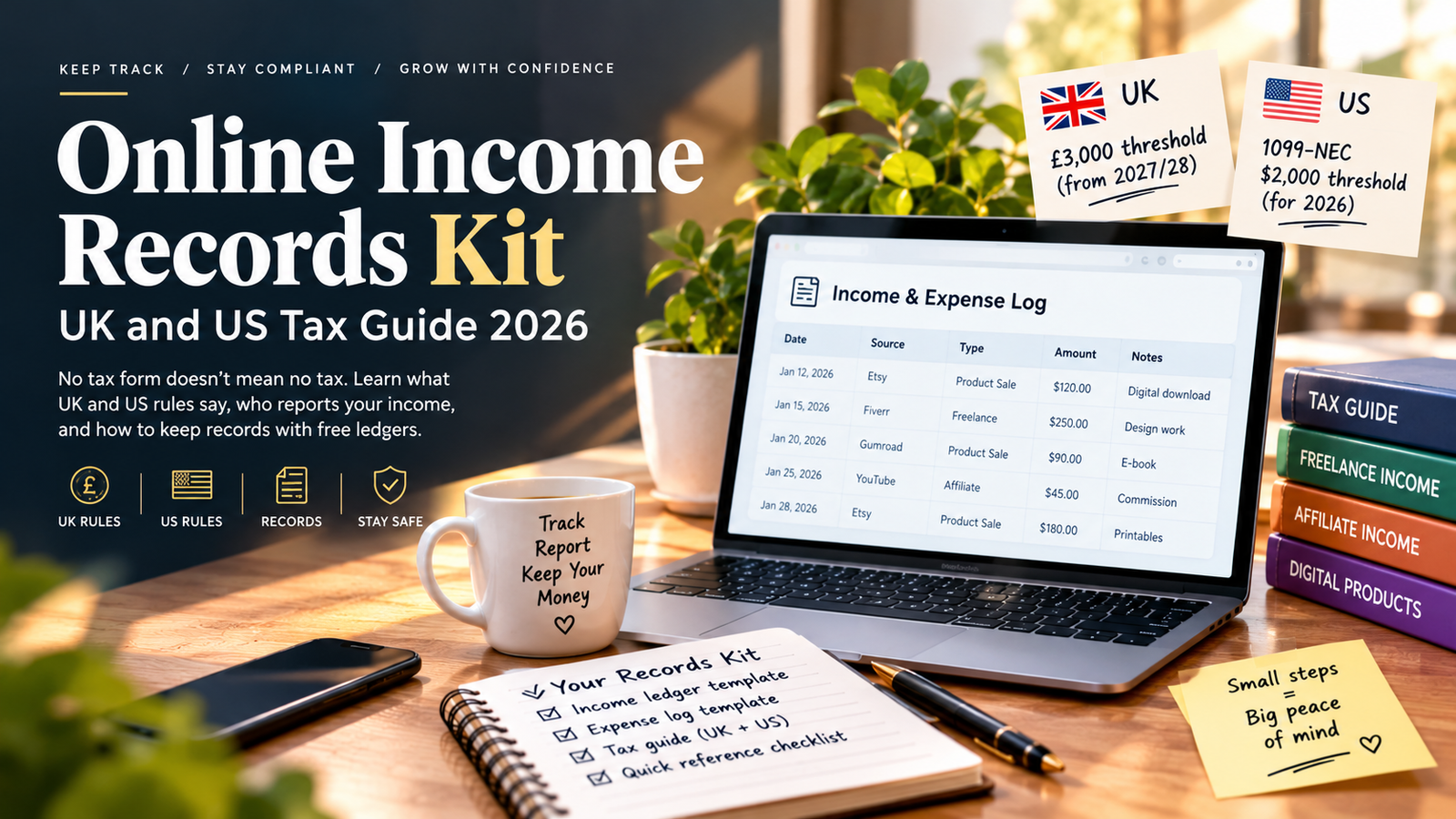
| Future change | Secondary sources say the reporting threshold for trading income rises to £3,000 from 2027/28. Confirm on GOV.UK | Secondary (ByteStart) |
What do the US rules say?
| Topic | What the source says | Source |
|---|---|---|
| 1099-K threshold | Third-party settlement organizations must issue a Form 1099-K when gross payments exceed $20,000 and transactions exceed 200. The One Big Beautiful Bill Act retroactively restored this threshold | Taxpayer Advocate Service |
| No form, still taxable | All income from selling goods or services is taxable, even without a Form 1099-K | IRS |
| Forms below the threshold | A company may still issue a form for less, and a state may have a lower reporting threshold | IRS |
| Gross, not profit | A 1099-K shows gross payments, so you track costs and refunds yourself | IRS and Taxpayer Advocate Service |
| Self-employment filing | The Taxpayer Advocate page mentions a filing trigger when net income from 1099-K sources exceeds $400, even without a form | Taxpayer Advocate Service |
| 1099-NEC and 1099-MISC | Secondary sources report the threshold rising from $600 to $2,000 for 2026. Confirm on IRS.gov | Secondary |
Who reports what for each income stream?
This is where most advice stops. Online earners rarely have one income type, so the useful question is: who pays me, and do they report it? The table below marks what I could and couldn’t confirm. “Check your payer” means I found nothing definite, so don’t assume.
| Income stream | UK | US |
|---|---|---|
| Marketplace sales (for example Etsy, eBay) | Likely reported UK platforms report sellers above the casual-seller limits | Form if over $20,000 and 200 transactions or below, if the platform chooses |
| Direct sales through a checkout platform | Check your platform Depends on whether it is a reporting platform for you | Check your platform Payment processors may issue a 1099-K |
| Freelance platform payouts (services) | Check your platform GOV.UK says platform reporting covers services as well as goods | Check your platform A 1099-K or 1099-NEC may arrive |
| Affiliate commissions | Don’t assume Taxable as trading income if you are trading. I found no rule that networks report it | Check your payer Networks may issue a 1099-NEC or 1099-MISC above the threshold |
| Ad revenue (for example AdSense) | Don’t assume Taxable if you are trading | Check your payer May receive a 1099-NEC or 1099-MISC |
The downloadable stream map lets you fill in, for each payer, the currency, payout schedule, whether it reports and where you saved its statements.
Why won’t UK platform reports match your tax year?
This catches many people. GOV.UK says platforms report on a calendar year, so the first reports covered 1 January to 31 December 2024. The UK tax year for Self Assessment runs from 6 April to 5 April. A platform report for 2025 therefore combines parts of two tax years.
To reconcile, split your ledger by date. Add every payment from 6 April to 31 December of one year, and from 1 January to 5 April of the next, then compare each part with the matching part of the calendar-year report. The ledger’s date column makes this a filter, not a rebuild.
What should you record for every payment?
- Date received and the tax period it belongs to
- Income stream and payer (platform, network or client)
- Gross amount before fees, plus platform fees and refunds as separate columns
- Net amount received and the payout reference
- Currency, and the exchange rate and its source if you convert
- Reported by the payer? yes, no or unknown, and the amount they reported
- Evidence: where the statement or invoice is saved
Record gross and net separately. Reports and forms commonly use gross figures, while your profit depends on costs and refunds you track yourself.
What is a 15-minute monthly routine?
- Download the month’s statements from each platform, network and payment account.
- Enter each payment in the income ledger with gross, fees, refunds and currency.
- Enter costs in the expense log, with a receipt reference.
- Mark reporting: note whether each payer says it reports income to a tax authority.
- Save evidence in one folder per tax year, using the same file names as your ledger.
- Check your running total against the £1,000 or $400 level that matters to you.
Should you use the trading allowance or claim expenses?
In the UK, GOV.UK says that if gross income is over £1,000 you can use the allowance instead of deducting expenses. It is one or the other for the same income, so what matters is which gives the lower taxable profit. The example below uses fictional numbers.
| Gross income | Actual expenses | Taxable profit with allowance | Taxable profit with expenses | Lower option |
|---|---|---|---|---|
| £3,000 | £400 | £2,000 | £2,600 | Allowance |
| £3,000 | £1,500 | £2,000 | £1,500 | Expenses |
Because the allowance replaces expenses, keep your expense log anyway. Without it you can’t compare the two options, and expenses may matter if your income grows.
What costs do online earners commonly track?
Many online earners log domain and hosting, software and AI subscriptions, stock assets and fonts, platform fees, and payment fees. Whether a cost is allowable, and how, depends on your country and circumstances, so ask your adviser before you deduct anything. Keep receipts either way.
How long should you keep your records?
The period is set by your tax authority. In the UK it is generally at least five years after the 31 January Self Assessment submission deadline for that tax year, and in the US generally three years from filing for most returns. I am stating these from general knowledge and have not verified them for this article, so confirm the current periods on GOV.UK and IRS.gov. Keep platform statements, invoices, receipts and your ledger for at least as long.
What should you ask an accountant?
- Am I trading, or is this a hobby or one-off income?
- Do I need to register, and by when?
- Allowance or actual expenses: which suits me this year?
- How should I treat foreign currency payouts?
- Do platform fees, AI tools and software count as costs for me?
- Do I need to register for VAT or collect sales tax?
- How long must I keep each type of record?
FAQ
Do I have to report income if I don’t get a tax form?
What is the UK trading allowance?
Do UK platforms report my income to HMRC?
Does a platform report mean I owe tax?
What is the 1099-K threshold in 2026?
Is affiliate income reported by the network?
Why don’t my platform report and my records match?
Do I need an accountant?
Where to start
Open your payout history from the last twelve months, enter every payment in the ledger with gross, fees and the payer, and mark which payers report. That one afternoon gives you the cross-check that makes every future form or report easy to verify.
GOV.UK: Tax-free allowances on property and trading income · GOV.UK: Selling goods or services on a digital platform · Taxpayer Advocate Service: I received a Form 1099-K · IRS: Form 1099-Ks issued for selling goods or services · ByteStart: trading allowance (secondary, £3,000 from 2027/28) · Patriot Software: 1099 threshold for 2026 (secondary). Rules and thresholds change. Confirm on official pages or with a qualified adviser. General information, not tax, legal or financial advice.