Affiliate Reviews That Show Their Work: A Testing-Proof Kit for Google and AI Answers
Google’s review guidance asks for evidence of your own experience, reasons behind any “best” claim, and links to multiple sellers. To show it, label how much you tested, log each test with dated evidence, and put the verdict and proof near the top. Then check monthly whether AI answers cite your page. Nothing here guarantees rankings or citations.
In this guide
- Google says to show evidence of your own experience, explain why something is “best”, and offer multiple sellers
- Google says no special optimization is needed for AI Overviews or AI Mode. The page must be indexed and snippet-eligible
- Label what you did: tested, used in real work, researched, or reported by others. Never imply more than you did
- Studies on traffic loss disagree, so measure your own visibility instead of trusting one headline number
What do Google and AI answers actually ask for?
Google’s guidance for reviews is short and specific. It recommends that you provide evidence such as visuals, audio or links showing your own experience with what you’re reviewing. It suggests linking to multiple sellers so readers can buy from their preferred merchant. When you call something the best overall or best for a purpose, it says to include why, with first-hand supporting evidence. It also asks that ranked lists contain enough useful content to stand on their own, and says to focus on quality and originality, not length.
The flip side is defined too. Google’s spam-reporting page describes thin affiliate pages as pages that aggregate product descriptions and links for affiliate commissions without adding substantial value.
For AI features, Google’s documentation says specific optimization isn’t required. To appear as a supporting link in AI Overviews or AI Mode, a page must be indexed and eligible to be shown in Search with a snippet. The same SEO fundamentals still matter. It also says traffic from these features is included in your overall Search Console totals. In short, nobody is selling a secret: what you can control is real evidence, clear structure and crawlable pages.
What does the traffic data say?
Studies disagree, which is why one headline number shouldn’t drive your strategy.
| Source (as reported) | Finding |
|---|---|
| Ahrefs, via an affiliate statistics roundup | Click-through for the top organic result was about 58% lower when an AI Overview appeared, up from a 34.5% reduction reported earlier |
| Digital Content Next, via an analysis post | Median year-over-year decline in Google referral traffic of 10% across 19 publishers, with some sites hit much harder |
| Affilifest roundtable, 2026 | Brands are increasing spend with partners that have real audiences and editorial authority, and publishers say AI summaries sometimes surface scraped, expired or incorrect discount codes |
Two practical points follow. First, your own Search Console and analytics matter more than any average. Second, relying on a single source of traffic is risky, which is why this kit also works for Pinterest pins, email and direct visitors. For Pinterest-specific rules, see our guide to Pinterest affiliate disclosure.
What are the four evidence labels?
Not every review can be based on months of testing, and pretending otherwise is the fastest way to lose trust. Label what you did, and show the label at the top of the review.
| Label | You can say | Evidence to keep |
|---|---|---|
| Tested hands-on | “I tested this” with the dates, plan and steps | Dated screenshots or recordings from your own account, notes, results |
| Used in real work | “I use this for [task]” and how long | Real outputs, invoices or project files with private details removed |
| Researched, not tested | “I haven’t tested this. Here is what its documentation and users report” | Links to official docs and the sources you compared |
| Reported by others | “Users report…” with attribution | Links to the reviews or discussions you read |
Here is how the top of a review can look. The product is fictional, and the card is only a layout example.
- Tested
- October 2026, Pro plan, 14 days
- Retest
- January 2027
- Verdict
- Good for solo creators, slow with large files
- Not for
- Teams that need shared workspaces
- Price checked
- October 11, 2026, on the seller’s page
- Disclosure
- I earn a commission if you buy through my link
What counts as proof?
Proof is anything that shows you actually did the thing and that a reader or a reviewer can check. The strongest evidence is specific, dated and connected to your own account or product.
| Product type | Strong evidence | Weak evidence |
|---|---|---|
| Software or AI tool | Screen recording of a real task, dated screenshots of your settings and results, time or cost log | The vendor’s marketing images |
| Physical product | Your own photos with scale, measurements, wear after weeks of use | Stock photos or retailer images |
| Service or course | Your receipts, sample outputs, notes from sessions, how you were treated | A summary of the sales page |
Three rules protect you. Never invent or stage a test, because that creates trouble under the FTC’s endorsement rules as well as with readers. Remove private data from screenshots. And if you didn’t test something, use the “Researched” label and say so.
What does a proof-first review page look like?
- Verdict first. Two sentences on who it suits and who should skip it.
- Evidence label and dates, in a box at the top, as in the example above.
- How I tested. Three to five lines on the scenario, plan and duration.
- Results with numbers. Time saved, errors found, measurements, not adjectives.
- Pros and cons, including at least one real drawback.
- Alternatives. Two or three, with why you’d choose each.
- Price and where to buy, with the date checked and, where it makes sense, more than one seller.
- Disclosure, in plain words above the first affiliate link.
- Updated and retest dates.
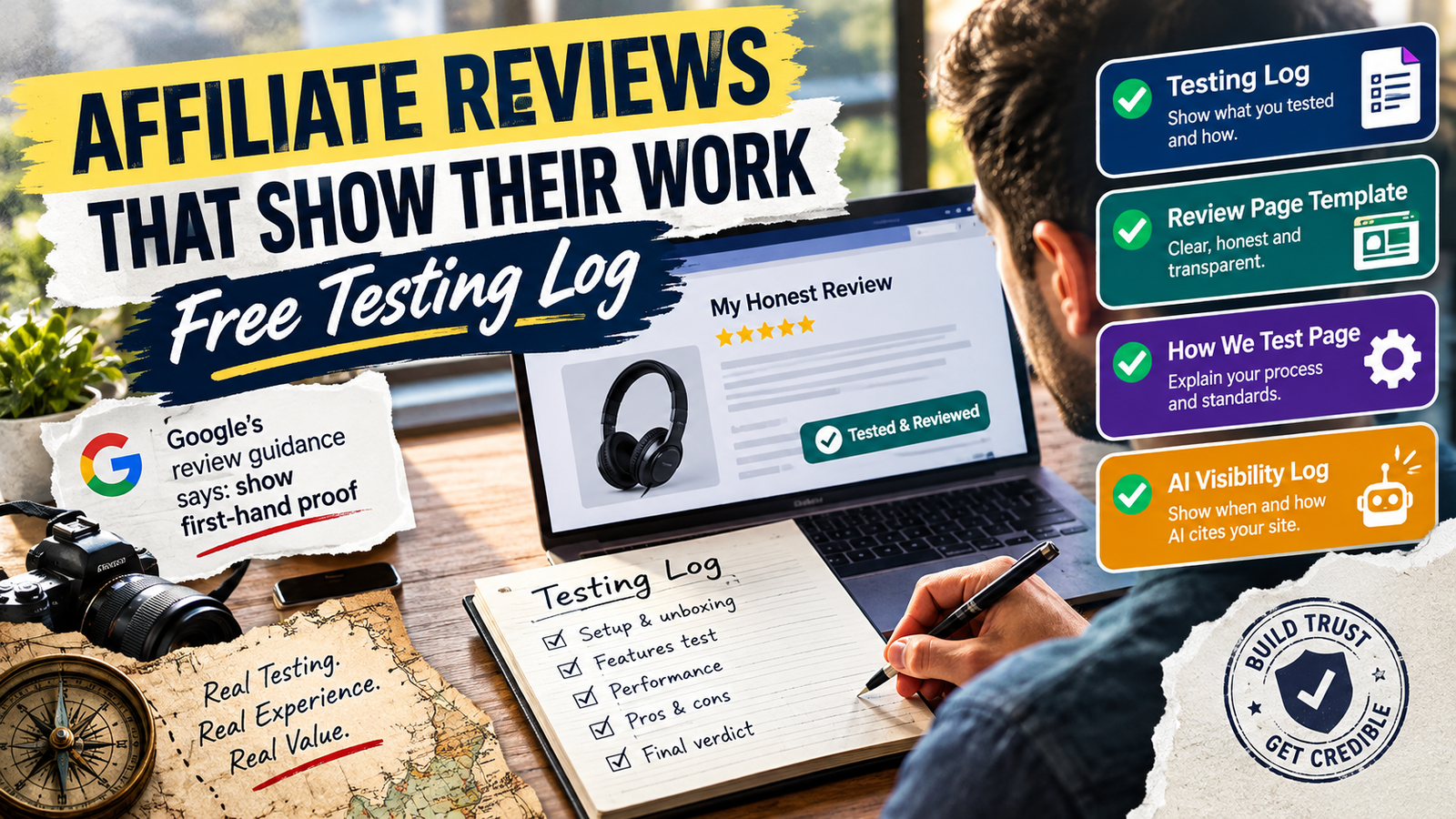
Add a short How We Test page and link to it from every review. It explains your process once, so each review doesn’t need to. The downloadable template includes one you can adapt. For the program side of the picture, see our affiliate program terms checklist.
How do you write ranked lists that stand on their own?
Google says ranked lists and comparisons are subject to the same review principles, and that a ranked list should contain enough useful content to stand on its own, even if you write separate in-depth reviews. For each pick, give a “why it’s best” sentence backed by evidence.
How do you check whether AI answers cite your reviews?
Google gives no per-page report for AI citations, so check by hand. Once a month, ask the tools your readers use the questions they’d ask, and record what happens.
- Pick 15 buyer questions for your niche. The prompts file has starter patterns.
- Run each in the tools you care about, such as Google AI Mode, ChatGPT and Perplexity, logged out where possible.
- Run each question three times. Answers vary between runs, so one result proves little.
- Log the outcome: were you cited, named or linked, and was what it said accurate?
- Fix what you can control. If an answer misstates your facts, put the key facts in plain text near the top of the page. Check that snippet controls aren’t blocking you, since Google says nosnippet and similar controls limit what appears in AI features.
Treat the log as a trend line, not a scoreboard. If you’re cited more often over three months while your reviews improve, that’s a useful signal. It isn’t proof of cause.
How do you upgrade an existing review in 30 minutes?
- Pick your top affiliate review by traffic or revenue.
- Choose the honest label. If you did not test it, use “Researched” and say so.
- Add the top box: label, test or research dates, verdict, who it’s not for.
- Add proof you really have: screenshots, photos, a short recording, or links to your sources.
- Check the price and sellers, and add the date checked.
- Move the verdict above the first affiliate link, and link to your How We Test page.
FAQ
How do I show first-hand experience in an affiliate review?
Do I need to test every product I recommend?
How do I get cited in AI Overviews or AI Mode?
Should my reviews link to multiple sellers?
What is a thin affiliate page?
Do ranked lists need separate reviews?
How often should I retest products?
Will this bring my traffic back?
Where to start
Open your highest-earning review, choose the honest evidence label, and add the top box with real dates. Then log your next product test the day you do it, not weeks later.
Google Search Central: Write high quality reviews · Google Search Central: AI features and your website · Google: Product review ranking, one year on · Google: Search Quality User report (thin affiliate pages) · Affilifest North: AI, affiliate marketing and discovery in 2026 · ClickDealer: Q3 2026 affiliate statistics · Rexultz: AI Overviews and affiliate sites. Guidance changes; confirm on the official pages. General information, not legal advice.