Getting Paid to Train AI: How to Vet Platforms, What Pay Claims Really Look Like, and How to Protect Your Earnings
AI training and data annotation work is a real category: workers write, rate and correct material used to build AI systems. Legitimate platforms are free to join, but pay claims vary widely, work can dry up, and accounts can be removed with money unpaid. Check the platform is free, official and clear about how it pays, keep your own records, and never rely on it as your only income.
In this guide
- Legit platforms don’t charge to join. Any request for a fee, deposit or “starter kit” is a red flag
- Published pay claims range from single digits to over $100 an hour, depending on source, skill and project
- TIME reports workers whose accounts were deactivated with earnings still unpaid, so keep evidence of every task
- Assessments are unpaid, rejection is often silent, and passing doesn’t guarantee steady work
What is AI training work?
TIME describes data annotation as work humans do to train AI: completing tasks such as writing and coding that tech companies then use to develop AI systems. Demand has grown as companies build models, and the work is moving toward more specialised skills. A Partnership on AI researcher told TIME that higher-quality AI needs higher-quality data.
TIME also warns that the industry is poorly regulated and opaque, which makes it hard to navigate. Some platforms are branded openly, such as Amazon Mechanical Turk and Upwork. Others are worker-facing brands of larger data companies. TIME notes Remotasks is Scale AI’s worker-facing subsidiary, and reports that DataAnnotation.tech and others are reportedly subsidiaries of Surge AI.
How does applying work?
Most platforms start with an assessment. TIME says users commonly report times from one to three hours, and that applicants who aren’t accepted typically hear nothing. Some people report passing and then never receiving tasks.
DataAnnotation’s FAQ adds specifics: you can take its Starter Assessment only once, and if you qualify for its long-running projects and show high-quality work, work will be available to you. The same FAQ page lists a question about why you can’t reach anyone in customer service, which hints at the support problems workers describe elsewhere.
What do the pay claims look like?
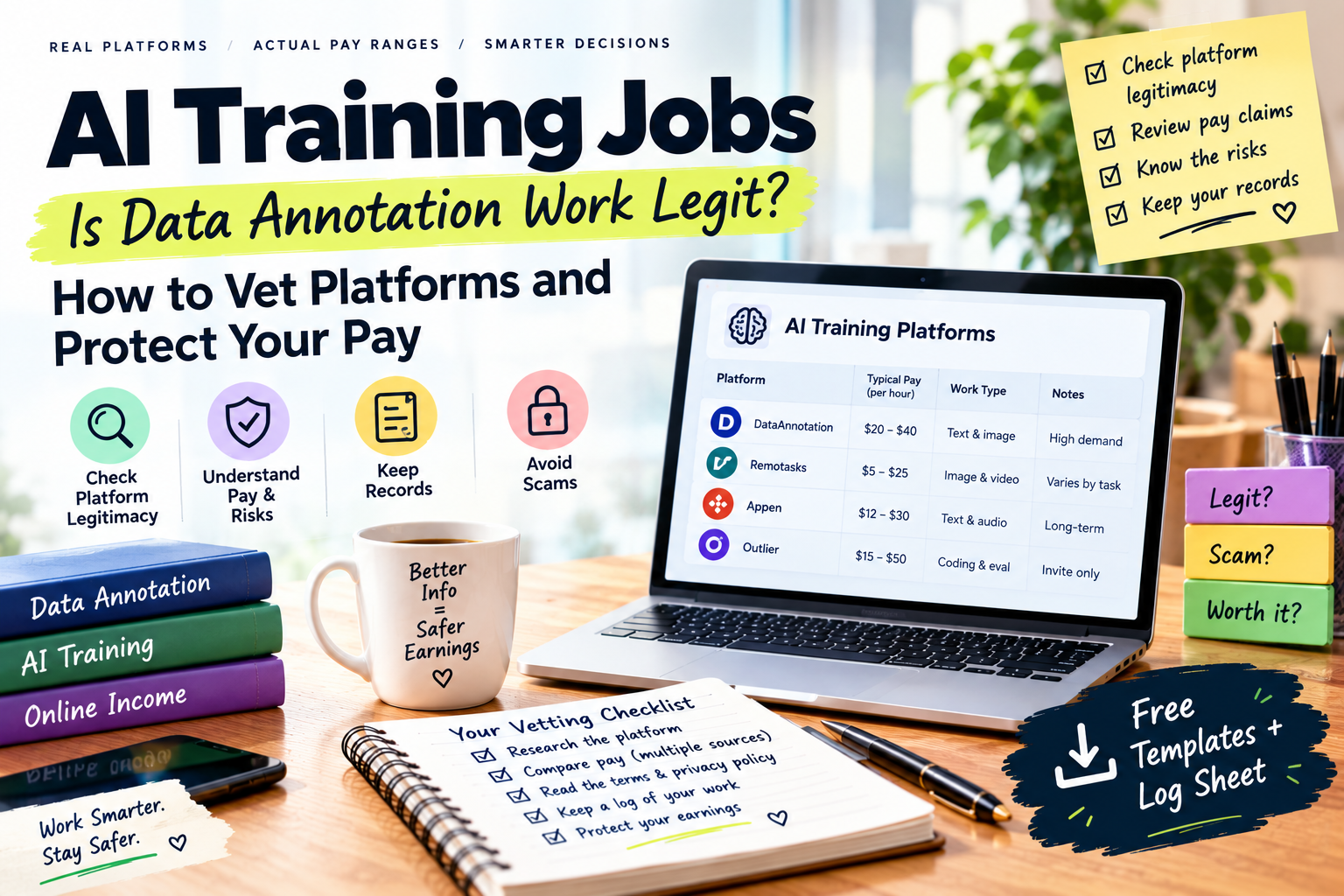
This chart shows hourly figures claimed by different sources. They are advertised or reported figures, not verified earnings, and they are not what you should expect.
TIME gives concrete examples from 2024: about $20 an hour for photo labeling and writing exercises in the US, $40 for coding tasks on DataAnnotation.tech, and $60 for chemistry tasks on Outlier. It adds that data labellers outside the US are typically paid a lot less. The wide spread in the chart is the real finding: the same category is described as both a few dollars and well over $100 an hour, and most of these pages are review or affiliate sites with their own incentives. The downloadable ledger records each figure with its source.
What can go wrong?
| Risk | What the sources say |
|---|---|
| Account removal with unpaid earnings | TIME reports users whose accounts were deactivated with large amounts of earnings unpaid, including one who reports $2,869 of unpaid work and no reply from support. This is an individual report, not a measured rate |
| Silent rejection | Applicants who fail an assessment typically hear nothing (TIME) |
| Uneven work | Review sites describe tasks that come and go, and empty queues without explanation |
| Opaque companies | Worker-facing brands may belong to larger data companies, which makes it harder to know who you work for |
| Impersonators and task scams | The FTC warned in April 2026 about “online assessor” texts that lead to task scams, where you must deposit your own money to unlock earnings |
| Currency and fees | Payouts via PayPal or similar may involve conversion or transfer fees in some countries |
How do you vet a platform before applying?
Run any platform through these checks before you enter personal details. Use the scorecard to record the answers and the date.
| Check | Pass looks like | Fail looks like |
|---|---|---|
| Cost to join | PASS Free, stated plainly | FAIL Any fee, deposit or starter kit |
| Official site | PASS You typed the address yourself and it matches the company’s own pages | FAIL You arrived through a text, DM or ad |
| Who runs it | PASS A named company you can verify | FAIL No company details |
| How you are paid | PASS Method and schedule stated in its FAQ | FAIL Gift cards, crypto only or vague promises |
| Rates | PASS Shown inside the platform before you start | FAIL Only a marketing headline |
| Assessment | PASS Rules stated, no payment needed | FAIL Pay to unlock tasks |
| Account terms | PASS You read the removal and payout terms | CHECK Terms not found or unclear |
| Support | PASS A written support route exists | CHECK No visible way to reach anyone |
| Your country | PASS Listed as supported | FAIL Not supported, or you’d need to hide your location |
For DataAnnotation, its own FAQ states it charges no signup fees and sends payments through PayPal. That passes the first and fourth checks, but it doesn’t settle the rest. One discussion thread says it is available in the USA, Canada, Australia, New Zealand, the UK and Ireland, so check the current list on its own site.
How do you protect your earnings?
- Read the account and payout terms before you work, including what happens if an account is removed.
- Log every task. Record the date, project, minutes worked, the rate shown and a screenshot of your dashboard. The earnings log has columns for each.
- Cash out when you’re eligible. Check how payouts work on that platform, and don’t leave a large balance sitting if you can withdraw it.
- Never share or sell your account, and don’t create duplicates. Platforms commonly treat that as a violation.
- Keep support messages in writing, with project names, dates and amounts.
- Don’t depend on it. Reviews describe work that comes and goes, so keep other income in place.
Contractor income is generally taxable even without a form. See our online income records kit for what to record and how to reconcile payouts.
What does the scam filter look like?
- Unsolicited offers by text, WhatsApp or Telegram. The FTC advises ignoring generic, unexpected job messages.
- Any upfront payment: fees, deposits, “equipment” or “verification” charges.
- Lookalike websites. Type the address yourself. One review site warns that only one domain is legitimate for DataAnnotation, so check the address on the company’s own pages.
- Early requests for ID or bank details before you have passed an assessment and have a written agreement.
- Payment only in gift cards or crypto.
Is AI training work right for you?
| It may suit you if | It may not suit you if |
|---|---|
| You have writing, coding or subject expertise, and can follow detailed instructions precisely | You need predictable weekly income |
| You’re comfortable with unpaid assessments and uneven work | You can’t afford to lose access to unpaid earnings |
| You keep records and can be patient with slow support | You want a fast, guaranteed start |
FAQ
Is data annotation work legit?
Do AI training platforms charge to join?
How much does AI training work pay?
Can I retake the DataAnnotation assessment?
Why was my account removed?
Do I have to pay tax on AI training income?
Can I do this from any country?
Is a text offering “online assessor” work real?
Where to start
Pick one platform, run it through the scorecard before you enter any personal details, and open your earnings log before your first task. If any check fails, skip it. There will be other options.
TIME: Side Hustle or Scam? What to Know About Data Annotation Work · DataAnnotation: Frequently Asked Questions · FTC consumer alert, April 2026 · FTC: Job scams · The Verge on data labeling labor (cited by TIME) · Pay figures from review and roundup sites: Finder, Second Talent, AITraining.jobs, The AI Rankings (all unverified). Platforms, pay and policies change; confirm on official pages. General information, not financial or legal advice.